Overview of electronic water pump
(principle, characteristics, failure mode)
1. Structure and working principle of electronic water pump
The water pump is an important component of the automobile engine cooling system. Its main function is to drive the coolant circulation, absorb the engine's excess heat, and transfer it to the outside air through the heat dissipation device to prevent the engine temperature from being too high. If the engine temperature is too high, the lubrication ability of the engine oil will decrease, resulting in increased wear of the parts. When the temperature reaches a certain value, it will cause serious faults such as engine cylinder pulling or burning, and eventually cause the engine to burn out and be scrapped.
Water pumps are divided into traditional mechanical water pumps and electronic water pumps. Traditional engines generally use mechanical water pumps, which drive the water pump bearings and impellers to rotate through pulleys. The impeller drives the coolant in the water pump to rotate together. Under the action of centrifugal force, it is used to the edge of the water pump housing, and a certain pressure is generated simultaneously, and then it flows out from the outlet or water pipe.
The pressure at the center of the impeller is reduced due to the cooling liquid being thrown out. The coolant in the water tank is sucked into the impeller through the water pipe under the pressure difference between the water pump inlet and the impeller center, realizing the reciprocating circulation of the coolant.
The working principle of the electronic water pump is as follows: the ECU (electronic control unit) adjusts the duty cycle through PWM (pulse width modulation) according to feedback signals such as water temperature and transmits the signal to the controller inside the electronic water pump. The controller controls the rotation of the motor according to the duty cycle, thereby driving the impeller rotor to rotate, realizing the circulation of coolant.
The traditional mechanical water pump works based on the engine speed, which means that even in cold start and low-load and high-speed conditions with low flow demand, it still requires a lot of power to drive. At this time, the cooling capacity provided is far greater than the cooling energy actually required by the engine, and it requires a lot of power to drive.
In this way, a large part of the cooling capacity of the mechanical water pump is wasted, which consumes a lot of additional driving capacity, and the cooling effect is different from the actual requirements of the engine, which will cause the power and economy of the engine to decline. The electronic water pump can accurately control the flow rate according to the demand of the cooling device for coolant.
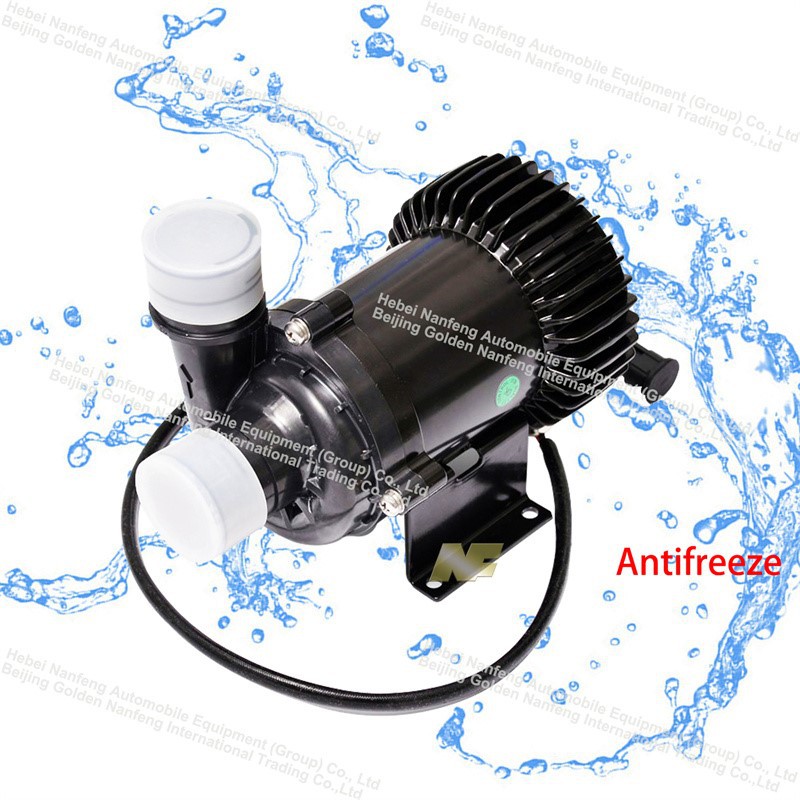
The electronic water pump consists of a pump housing, an impeller, a sealing ring, a motor housing, an electrical plug, a motor assembly, a bearing, a rotor, a controller, a control seat, a rear cover, fixing bolts, etc., as shown in Figure 1.

ECU adjusts the duty cycle through PWM according to feedback information such as water temperature. The controller connects the wiring harness through the electrical finger and then controls the motor to drive the impeller and rotor according to the duty cycle, thereby realizing the coolant circulation and ensuring precise control of the coolant flow rate. The sealing ring ensures the sealing between the pump housing, motor housing, controller seat, and rear cover. The pump housing, motor housing, and rear cover seal the internal components of the electronic water pump in a dust-free environment to ensure the reliability of the electronic water pump.
2. Features of electronic water pump
1) Provide timely and appropriate cooling capacity, low energy consumption and high efficiency, realize precise control of coolant flow according to information such as water temperature, reduce the coolant flow distance and reduce the water pump displacement by about 60%.
2) Reduce friction. The electronic water pump is driven by electricity. Compared with the mechanical water pump driven by the accessory belt, the friction work is reduced. The NEDC (New European Driving Cycle, which is the European endurance test standard) cycle can reduce fuel consumption by about 2%.
3) Accelerate warm-up. For hybrid engines, due to frequent start-stop, a faster warm-up speed is required. Since the displacement of the electronic water pump can be controlled in real-time, reducing the coolant flow during a cold start can achieve the effect of accelerating warm-up, reducing fuel consumption and emissions.
4) Longer service life, continuous working time is more than 20,000 hours.
5) The risk of water leakage is greatly reduced. The impeller of the mechanical water pump is pressed on the water pump bearing with an interference fit, while the integrated magnetic impeller of the electronic water pump is driven by a magnetic core installed in the water pump housing, which can realize the separation of the water cavity and the outside, remove the water seal, and reduce the risk of friction loss and water leakage.
6) Flexible control mode (PWM, bus).
7) Multiple working protections (overtemperature, overpressure, overcurrent, etc.).