New energy vehicle air conditioning refrigeration system
The air conditioning system of new energy-pure electric vehicles is mostly driven by electricity and has certain inherent advantages in cooling and heating performance compared with traditional fuel vehicles. However, it also has a certain impact on the precious cruising range of electric vehicles. When using air conditioning, you must plan your driving route in advance and pay attention to the cruising range and power information at any time.
There are differences in the system structure between new energy vehicles and traditional vehicles, and different types of new energy vehicles have different characteristics. For purely electric vehicles, there is no engine as the power source of the air conditioning compressor, and the engine waste heat cannot be used to achieve the effect of heating and defrosting. For hybrid vehicles, the engine cannot be used as a power source for refrigeration compression or a heat source for heating at any time due to its control strategy. Therefore, the air conditioning systems of the two are not the same. But in principle, the air conditioning system of new energy vehicles is the same as that of traditional fuel vehicles.
Refrigeration system:
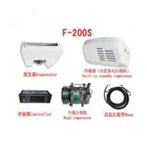
The refrigeration system of electric vehicles is the same as that of traditional power vehicles. It consists of a compressor, condenser, evaporator, cooling fan, blower, expansion valve, liquid storage dryer, and high and low-pressure pipeline accessories. The compressor of a traditional automobile air conditioner is driven by the engine belt through the electromagnetic clutch, while the electric vehicle uses an electric compressor driven by the high voltage electricity provided by the power battery.
When the automobile air conditioner is working, the compressor is driven by high-voltage electricity and sucks in the low-temperature and low-pressure gaseous refrigerant from the evaporator. After compression, the temperature and pressure of the refrigerant increase and are sent to the condenser. In the condenser, the high temperature and high-pressure gaseous refrigerant transfers heat to the air outside the car passing through the condenser and liquefying into liquid. The liquid refrigerant flows through the expansion valve, the temperature and pressure decrease, and enters the evaporator. In the evaporator, the low-temperature and low-pressure liquid refrigerant absorbs the heat of the air inside the car passing through the evaporator and evaporating into gas. The gas is sucked into the compressor for the next cycle. In this way, through the compression-condensation-expansion-evaporation cycle of the refrigerant in the system, it continuously absorbs the heat of the air inside the car and discharges it to the air outside the car, so that the temperature of the air inside the car gradually decreases.