
A detailed explanation of the three-electric
technology of electric vehicles
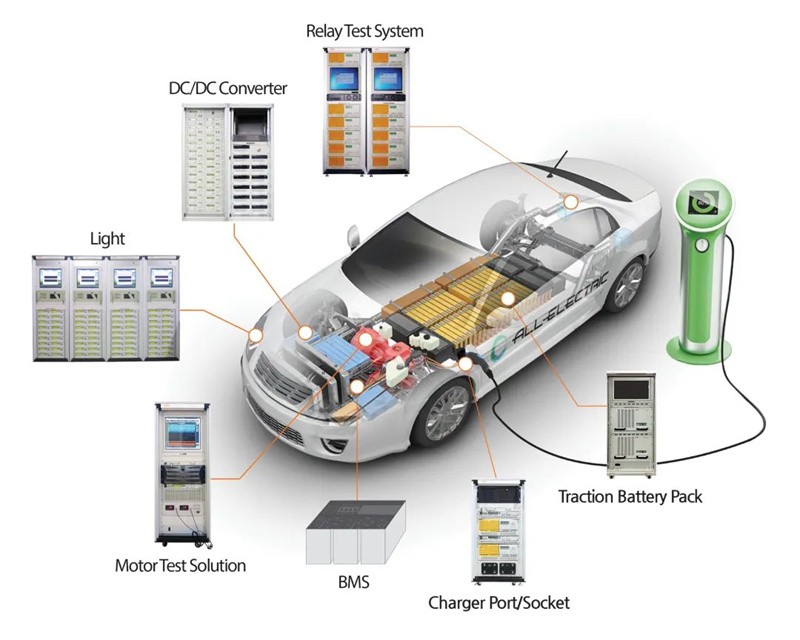
What is the "core technology" that distinguishes new energy vehicles from traditional ones? The "three-electric" they are talking about is: battery, electric drive, and electronic control.
Battery
Two batteries that are currently popular:
Blade battery: On March 29, 2020, BYD officially released the blade battery, which uses lithium iron phosphate technology. Structural innovation allows the "blade battery" to skip the "module" when grouping, greatly improving the volume utilization rate and ultimately achieving the design goal of installing more batteries in the same space. Compared with traditional battery packs, the "blade battery" volume utilization rate has increased by more than 50%, which means that the cruising range can be increased by more than 50%, reaching the same level as high-energy-density ternary lithium batteries. , The design of the "blade battery" makes it generate less heat and dissipate heat quickly when short-circuited, and its performance in the "needle puncture test" is evaluated as "very excellent".
Magazine battery: The essence of the magazine battery is a ternary lithium battery. It is a systematic technology that specifically improves the safety of power batteries. It is a complete set of safety technologies from the intrinsic safety tips of the battery cell to passive safety enhancement and active safety control. The four cores of the magazine battery include ultra-high heat-resistant and stable battery cells, ultra-strong heat-insulating battery safety cabins, extremely fast cooling systems, and full-time control of the fifth-generation battery management system.
Electric drive
The electric drive consists of three parts: motor, transmission mechanism, and inverter.
The motor consists of three parts: stator, rotor, and housing.
The key points of motor technology are stators and rotors.
The rotor is the main drive motor, which undertakes all functions related to the movement of new energy vehicles.
The motor of new energy vehicles has forward and reverse rotation. Forward rotation means moving forward and reverse rotation means reversing.
During the forward acceleration process of new energy vehicles, the motor is negative torque, and the accuracy of torque means the speed of acceleration of new energy vehicles. If the torque produces an error, the motor itself needs to complete the acceleration, and the mileage is converted into a battery that consumes the same amount of energy, and the cost of the battery is greater than that of the motor.
Therefore, the efficiency and performance of the motor of new energy vehicles are crucial.
Motor:
Electric motors on cars are not uncommon. Many automatic actuators are motors. However, these motors are low-voltage. In order to distinguish them from high-voltage motors, they are called drive motors, which means that the motors that drive the car can be one, two, or four.
At present, the drive motors of new energy vehicles mainly adopt the following two categories: AC asynchronous motors and rare earth permanent magnet synchronous motors.
Asynchronous motors have simple structures, are durable and low-cost, and are mainly used in electric buses, electric special vehicles and some cheap electric passenger cars.
Permanent magnet synchronous motors have high power density and efficiency and a wide speed regulation range, and their cost is slightly higher than that of asynchronous motors.
There is also an inverter
An inverter is a device that converts direct current into alternating current. If the inverter of a new energy vehicle can support a higher voltage, the corresponding voltage charging current and power will be larger, which means that the charging power can be proportionally amplified when charging with the same current, that is, the charging time will be shortened.
If the support voltage of the inverter is increased, the heat generated by the inverter will increase accordingly during charging. Then it is necessary to solve the heat dissipation problem of the IGBT (Insulated Gate Bipolar Transitor) module in the inverter, which is a key issue to improve charging efficiency. Right here.


