
Detailed explanation of inverters in electric vehicles
An inverter is a device that converts direct current (DC) supplied by the battery into alternating current (AC). The motor of an electric vehicle drives the wheels with this alternating current. To improve the energy efficiency of the entire electric vehicle, the energy loss of the inverter must be minimized.
Overview of inverters
An inverter in an electric vehicle is a device that converts direct current (DC) supplied by the battery into alternating current (AC). This is because the traction motor installed in electric vehicles is mostly driven by alternating current. The output power of the inverter is set according to the output power of the motor (30kW to 400kW, etc.).
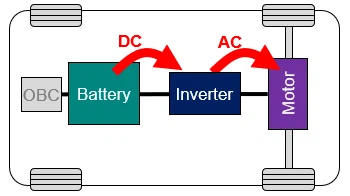
Usually, the number of inverters installed in a car is about 1 to 2. However, in the case of a hub motor type (a method in which each tire is driven by a motor), an inverter is required for each motor.
About the types of motors
There are two main types of motors, namely brushed disc motors and brushless motors. Brushed disc motors are used for small devices, and since they are driven by DC voltage, they are relatively simple to control. Brushless motors emphasize energy efficiency and are suitable for situations that require fine rotation speed (speed) adjustment. They are used in traction motors for driving, etc. Since they are driven by AC power, inverters that convert DC power to AC power are indispensable.
Market and equipment trends
As the number of electric vehicles increases, the number of inverters installed will also increase. In addition, as driving performance improves, motors are moving towards higher output, so inverters also need to have higher output (high power). As the functions/performance required of electronic components that constitute inverters in the future, "high power", "high heat resistance", and "miniaturization/lightweight" can be listed. The requirements for each are as follows.
- High power
To support the high output of the motor, the inverter also needs to have high output (high power). High power means high voltage (from the current 400V to 800V in the future) and high current, so the semiconductors that constitute the inverter are also required to support high power.
- High heat resistance
As electronic components are miniaturized, the amount of heat received per unit area is also increasing. By making them resistant to heat, aging caused by heat generated by the components themselves and heat received from surrounding components can be prevented.
- Miniaturization/lightweight
Factors such as high power make the equipment larger and heavier, which will affect the cruising range, so it is necessary to support high power while miniaturizing/lightweight.
Circuit structure of the inverter
Overall structure
The inverter is composed of the following circuits.
- Noise filter: Suppresses noise from the outside or the circuit
- Voltage measurement: Voltage measurement for controlling the conversion circuit
- Voltage conversion circuit: Converts voltage by switching operation through FET, etc.
- Current measurement: Current measurement for controlling the conversion circuit
- Control circuit: Controls the conversion circuit, etc.
- DC/DC converter: Supply power to the control circuit
- Communication IF: Communication circuit with the outside


